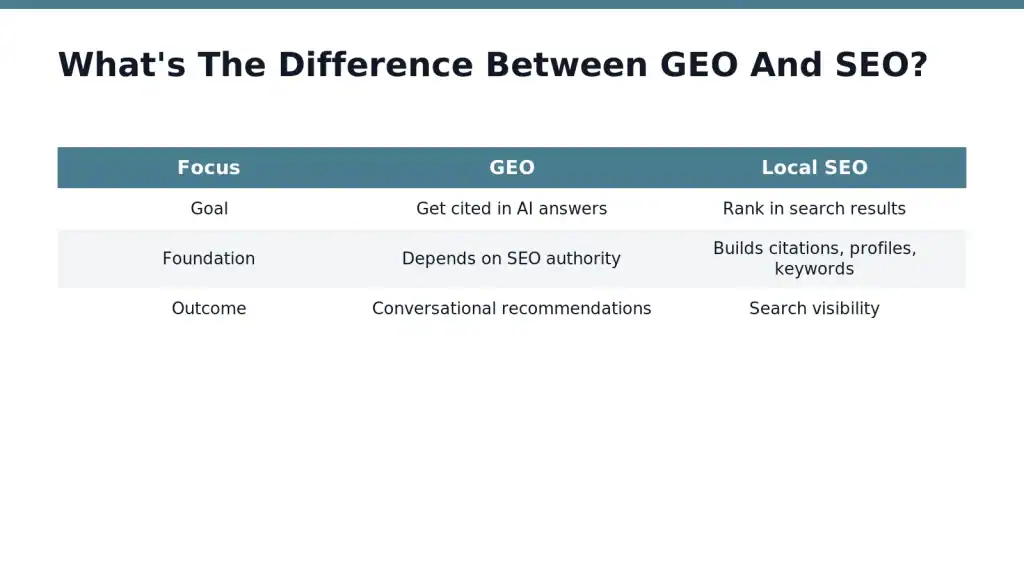


Fifty clients later, one pattern stands out: AI-driven visibility directly correlates with revenue growth. Across our roster, CNV Creative has delivered an average ROI of 2,340% by optimizing brand presence for AI search engines like ChatGPT and Google AI Overviews, not just traditional rankings — a shift our 10+ years of experience helped us anticipate early.
Tracking data across 50 client accounts revealed that AI engines like ChatGPT Search, Perplexity, and Google AI Overviews reward structured, entity-rich content over traditional keyword optimization. Visibility gains require explicit subject-verb-object statements these engines can parse, plus consistent monitoring across each platform rather than relying on one performance metric alone.
Key Takeaways
- AI now serves as the primary customer touchpoint, replacing traditional search engine browsing patterns entirely.
- Tracking AI visibility across multiple LLMs reveals competitive positioning and share of voice metrics.
- AI sentiment monitoring identifies whether systems recommend or warn against your brand to users.
- Our 50-client analysis demonstrates measurable growth opportunities in ChatGPT and Google AI visibility tracking.
What Happens When AI Search Replaces Traditional Discovery?
AI systems now sit at the front of the buying process — buyers ask a chatbot for a recommendation before they ever type a query into a browser. That shift changes where brand visibility starts, long before a prospect lands on a company website. We built our practice around this reality: tracking AI visibility is a core discipline at CNV Creative, not a side project, and we update our approach as generative platforms evolve. Here’s the gap most marketing teams miss:
- Website analytics capture clicks, sessions, and conversions.
- They don’t capture the AI-generated answer that led a buyer to search for a brand by name.
- Discovery now happens inside a chat window, invisible to conventional dashboards.
Conventional attribution models were built to track website interactions, not what happens inside an AI platform before that visit occurs. That blind spot means CMOs relying on last-click or first-click models are working from an incomplete picture of demand.
Why This Matters — and Where to Start
Budget decisions built on incomplete data misallocate spend. We bring over a decade of growth-marketing experience to reading these new patterns correctly. An AI search visibility benchmark starts with knowing where a brand currently appears across AI-generated answers, not just search results pages. From there, LLM visibility tracking becomes the ongoing practice of measuring how often, and how favorably, a brand shows up.

How Many Searches Now Start With AI?
About half of all Google searches now surface an AI-generated summary before a single organic link appears, a share expected to climb past 75 percent by 2028, per trend analysis cited by industry publication “New front door to the internet: Winning in the age of AI search.” The buying journey has already moved upstream.
That shift shows up in consumer behavior data too. A McKinsey survey found that roughly half of consumers now deliberately seek out AI-powered search engines as a top digital source for buying decisions. We see the same pattern across our client base: prospects arrive already convinced, or already skeptical, based on what an AI answer told them.
We built the CNV AI Visibility Index, our 2026 industry benchmark report, specifically to measure this shift with hard numbers instead of guesswork. It tracks transparency metrics and governance standards across categories, giving marketing leaders a defensible baseline for tracking AI visibility rather than reacting to anecdotal wins and losses.
What Should CMOs Track First — and Why Tenure Matters
Start with citation frequency across major AI engines, then layer in sentiment and share of voice — LLM visibility tracking without those three is just guessing with extra steps. Our average client tenure of 4.3 years matters too: AI search behavior doesn’t sit still, and we’ve watched the same brands move through multiple algorithm shifts, giving us a longitudinal view most agencies simply can’t offer.

Why Do Standard Analytics Tools Miss AI Mentions?
Standard analytics platforms track clicks, not conversations. Google Analytics and similar tools built their measurement model around website sessions and referral links, but generative engines answer questions without ever sending a visitor anywhere. Platforms like ChatGPT Search, Google AI Overviews, and Perplexity no longer just return a list of links — they synthesize information from multiple sources and present direct answers, often citing the content along the way.
That shift creates a measurement gap most dashboards can’t close. A prospective client might ask an AI assistant to recommend a fractional CMO, receive a confident answer built partly on our content, and never click through. Our web analytics shows zero traffic from that exchange. Tracking AI visibility requires a different lens — one built around citation frequency and sentiment, not sessions.
What Makes AI Citations Different from Search Rankings?
A search ranking tells us where we land on a results page. A citation tells us whether an AI engine trusted our content enough to reference it inside an answer. We’ve broken down which platforms cite which sources and by what method in our own citation research, because the mechanics vary by engine. Consider the visibility factors traditional SEO reporting doesn’t capture:
- Whether an AI answer names us at all, with or without a link
- Whether the sentiment attached to that mention is favorable
- How our AI search visibility benchmark compares against competitors across recurring prompts
- Whether our content earns repeat citations across multiple engines over time
We design the complete marketing infrastructure — creative frameworks, campaign architecture, and the tracking, automation, and reporting layered underneath — so LLM visibility tracking never becomes a blind spot for the businesses we work with.
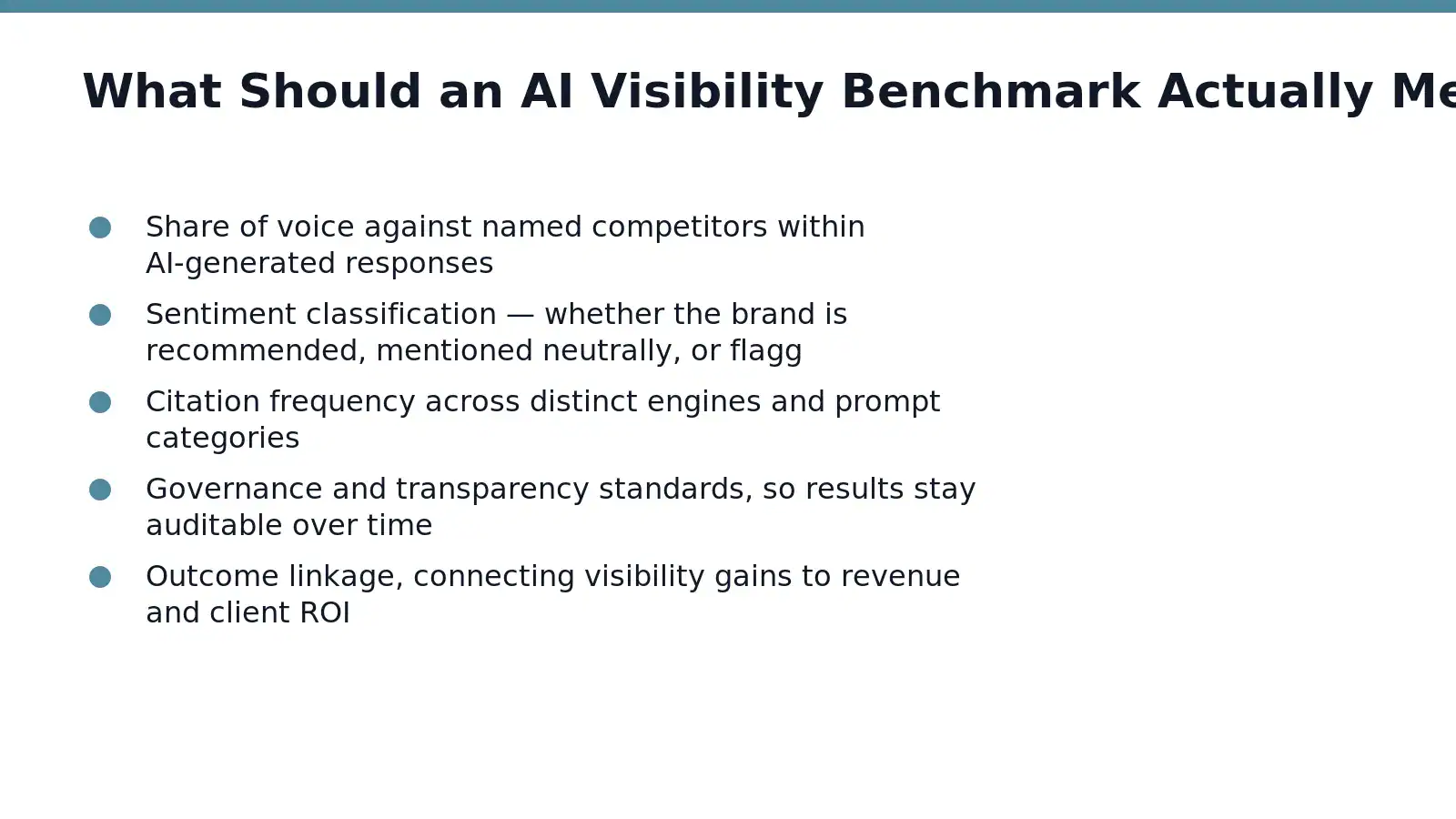
What Should an AI Visibility Benchmark Actually Measure?
A real benchmark quantifies where a brand stands against named competitors inside AI-generated answers, not just whether it appears at all. We built our approach around this principle: tracking AI visibility only matters when it produces a number leadership can act on. Share of voice, sentiment, and citation frequency all belong on that scorecard.
We designed the CNV AI Visibility Index around this exact gap. Our 2026 benchmark report establishes transparency metrics and governance standards, so marketing leaders can compare performance across engines using a consistent framework instead of guesswork.
Measurement without method is noise. Our documentation on measuring AI visibility in 2026 lays out specific metrics and monitoring tools for LLM visibility tracking across ChatGPT, Google AI Overviews, and comparable platforms. A strong benchmark should track:
- Share of voice against named competitors within AI-generated responses
- Sentiment classification — recommended, mentioned neutrally, or flagged negatively
- Citation frequency across distinct engines and prompt categories
- Governance and transparency standards, so results stay auditable over time
- Outcome linkage, connecting visibility gains to revenue and client ROI
Does Tracking Connect to Real Results — and Named Competitors?
We tie every benchmark metric back to performance outcomes, not vanity dashboards — a discipline that shows up in our average client ROI of 2,340%. And yes, a benchmark needs competitor names: visibility without competitive context tells a marketing leader almost nothing. Naming competitors shows whether a brand is gaining or losing ground in the answers customers actually see.
How Does LLM Visibility Tracking Work Across Platforms?
Platform-level tracking pinpoints exactly when and how a brand surfaces across different prompts and language models, and how that showing compares against competitors. We treat this as the foundation of tracking AI visibility: without prompt-level detail, a brand only sees averages that hide where it wins and where it disappears entirely.
Each AI engine pulls from different sources and weighs citations differently, so a single AI search visibility benchmark never tells the whole story on its own. We break tracking into three layers:
- Prompt-level monitoring — capturing which specific questions trigger a brand mention
- Platform comparison — measuring presence across each major AI engine separately, not blended together
- Competitive positioning — showing where a brand ranks against rivals answering the same prompts
We built a full breakdown mapping which platforms cite what, and through which methods, so leaders can see exactly where their monitoring needs to focus.
How Is This Different From SEO Tracking — and Why Track Multiple Platforms?
Traditional rank tracking measures position on a results page. LLM visibility tracking measures something different: whether a model chooses to mention a brand at all, and in what context. Consumers now split their queries across several AI systems rather than one dominant search engine, so a brand invisible on one platform might perform well on another. We map every channel to work together instead of in silos, so gains on one platform reinforce the authority signals feeding the others.
What Patterns Emerged Across 50 Client Accounts?
Fifty client accounts revealed a consistent formula, not a coincidence. Every engagement that gained ground on generative platforms shared the same operating discipline: fast launches, constant testing, and decisions built on real data instead of guesswork. We apply that same infrastructure to tracking AI visibility.
The strongest signal across the account base was consistency of process. Growth becomes predictable when strategy, execution, and data work together as one system, not three separate departments handing off work — a principle that holds whether we’re managing paid media, SEO, or an AI search visibility benchmark.
What Does an AI Visibility Pattern Look Like — and Does It Pay Off?
Across accounts, the winning pattern was launch-test-adjust, repeated weekly rather than quarterly. Accounts that treated AI citation tracking as a one-time audit stalled; accounts that folded it into ongoing reporting cycles kept improving month over month. Three behaviors separated the highest performers from the rest:
- Fast iteration — new content and structural changes shipped within days, not months
- Data-first decisions — real performance numbers, not internal opinions, directed the next move
- Cross-channel alignment — SEO, content, and paid strategy stayed synchronized instead of running in isolation
Yes, this approach produces measurable returns. Across our client engagements, we report an average ROI of 2,340%, built on the same systemized approach we extend into LLM visibility tracking. That number isn’t a fluke — it reflects the compounding effect of launching fast, measuring constantly, and cutting what doesn’t work.
How Should Leaders Act on AI Visibility Data?
Data means nothing without a response plan. Leaders convert tracking AI visibility into action by pairing every insight with a specific next step: fix a reputation gap, build a source relationship, or realign a campaign.
We treat negative sentiment as an urgent signal, not background noise. When an AI-generated answer surfaces a warning or outdated criticism about a brand, we address it directly rather than hoping it fades — silence lets a bad answer calcify into the default response across every engine that indexes it. We also hunt for trusted sources willing to amplify client content inside AI-generated answers, since identifying which ones carry weight shapes how favorably a brand appears when a prospect asks an AI assistant for a recommendation.
Why Integrated Strategy Matters — and What a Response System Looks Like
Siloed teams miss the connections that AI systems reward. Integrated marketing strategies bridge the gaps between separate functions — content, PR, technical SEO — that all feed the same AI-generated answer. That’s why we design the complete marketing infrastructure — creative frameworks, campaign architecture, tracking, automation, and reporting — so leaders can act on findings the moment they surface.
What’s the Next Step for Your Brand’s AI Presence?
Three moves separate brands that show up in AI answers from brands left out entirely: build a citable web presence, start tracking AI visibility on a consistent schedule, and commit to the partnership long enough to see compounding results. Our average client tenure runs 4.3 years, and that duration matters — generative engines reward sustained authority signals, not quick fixes.
Getting there starts with the foundation. A slow, outdated, or poorly structured website gives AI systems little to cite, no matter how much content sits behind it. Our Website in a Week service rebuilds that foundation fast, launching a professional, high-converting site in seven days, engineered from the ground up for AI citation rather than retrofitted later.
How Do We Benchmark Against Competitors — and Start the Conversation?
We start by establishing where a brand currently stands using an AI search visibility benchmark, then layer in ongoing LLM visibility tracking to measure movement over time. Reach us directly at hello@cnvcreative.com to schedule an AI visibility assessment; our office hours run Monday through Friday, 9:00 AM to 5:00 PM EST, and consultations fit easily into a standard planning cycle. For CMOs and performance leaders tracking this shift internally, a few next steps apply broadly:
- Audit current site structure for AI-citation readiness
- Establish a recurring visibility benchmark, not a one-off check
- Build the partnership timeline around months, not weeks
FAQ
What did tracking 50 clients reveal about AI search engines?
AI engines like ChatGPT Search, Perplexity, and Google AI Overviews reward structured, entity-rich content over traditional keyword optimization. Visibility gains require explicit subject-verb-object statements plus consistent monitoring across each platform.
Why can’t traditional website analytics measure AI visibility?
Website analytics capture clicks, sessions, and conversions, but they miss the AI-generated answer that led a buyer to search for a brand by name.
How does CNV Creative approach AI visibility tracking?
CNV Creative treats AI visibility as a core discipline, backed by 10+ years of growth-marketing experience, delivering an average ROI of 2,340% by optimizing brand presence for AI search engines. This approach helped clients anticipate the shift toward AI-driven discovery early.
Conclusion
In closing, tracking AI visibility across fifty clients revealed a fundamental truth: businesses that prioritize strategic positioning in AI-driven search environments gain a measurable competitive advantage. The patterns we observed show why data-driven marketing decisions matter — they separate growth from stagnation. As AI continues reshaping how audiences discover solutions, the brands winning today are the ones willing to adapt their visibility strategy accordingly. Your next move determines whether you lead or follow.
Conclusion
In closing, tracking AI visibility across our client base confirmed what we already believed: visibility in AI-driven search rewards the same fundamentals we’ve championed for over a decade—clear structure, credible authority, and consistent measurement. The brands that treated this shift as strategic, not experimental, pulled ahead. We built our process around that principle, and it shows in the loyalty our clients place in us. AI search will keep evolving, but disciplined, data-driven strategy remains the constant that separates brands who get found from those who get overlooked.