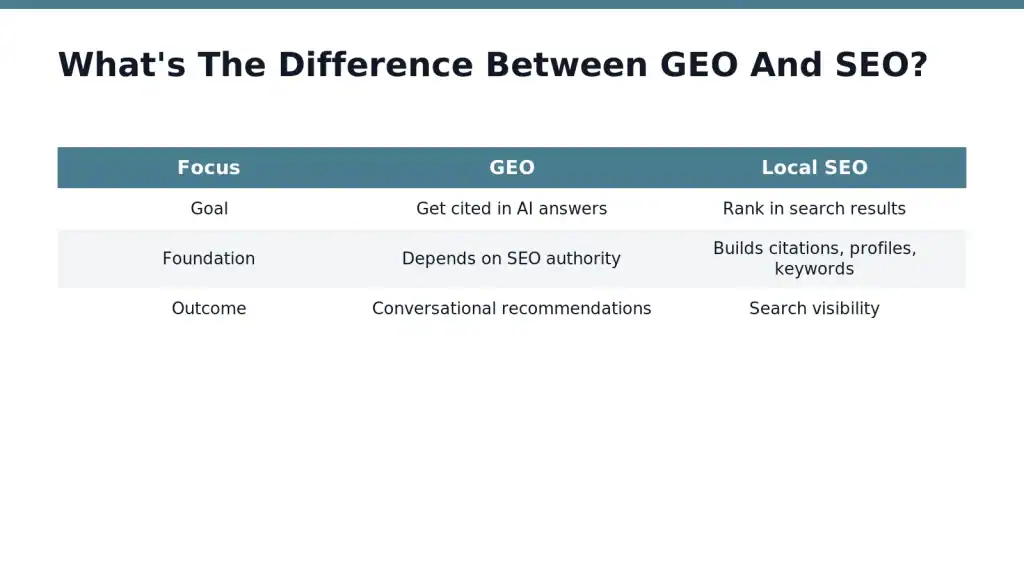


A generative engine optimization agency builds brand visibility inside AI-generated answers, not just traditional search
Growth-stage companies handle basic monitoring in-house—checking brand mentions in ChatGPT costs nothing and reveals real signal. GEO agencies become necessary once questions expand beyond brand name into competitive queries, requiring disciplined repeat-sampling and evidence archiving. We build this as one system, integrating answer engine optimization with SEO under unified strategic leadership rather than fragmented specialists.
Key Takeaways
- Start in-house by checking your brand name in AI tools monthly at zero cost.
- Hire an agency when tracking expands beyond your brand name to require disciplined sampling.
- Real GEO success means getting mentioned by name when buyers ask AI for solutions.
- CNV Creative’s 2,340% average ROI demonstrates measurable results that move actual pipeline revenue.
What Does a GEO Agency Actually Do?
A generative engine optimization agency builds brand visibility inside AI-generated answers, not just traditional search rankings. This work makes a brand findable, understandable, retrievable, credible, and useful inside search experiences that synthesize answers instead of simply listing links. That distinction matters more each quarter as buyers ask ChatGPT and other AI tools for recommendations before they ever open a browser tab. We treat this discipline as one piece of a larger system, not a bolt-on service — a full stack marketing agency handles strategy, creative, execution, and analytics under one unified structure, and that same integration applies when we build AI visibility for clients. Disconnected specialists create blind spots: strategy without execution stalls, and execution without analytics repeats mistakes nobody catches.
Is a GEO agency the same as an AEO agency?
Largely yes. An aeo agency — answer engine optimization — shares the same core goal: getting a brand cited by name when someone asks an AI tool for a recommendation. We use both terms because the market hasn’t settled on one, but the underlying discipline is identical. Most businesses considering the geo agency vs in house decision assume they have a marketing problem — they don’t. They have a fragmentation problem: scattered vendors, no shared data, no single team accountable for outcomes.
A capable agency partner typically delivers:
- Structured content that AI models can parse, cite, and trust
- Technical groundwork that makes brand information retrievable across platforms
- Ongoing monitoring of how and where a brand gets mentioned
- Integration with existing SEO, paid, and content strategy — not a siloed add-on
CNV Creative brings over 10 years of experience driving growth. We apply that track record to AI visibility the same way we apply it to every other channel: as one connected system, not a patchwork of vendors reporting different numbers.
What Criteria Should Decide Your GEO Approach?
Three variables settle the geo agency vs in house decision: speed, budget, and whether someone inside the company can own the work. Speed matters because generative engine updates happen constantly, and slow execution costs visibility windows that don’t reopen. Budget determines whether a team builds full-time capacity or borrows expertise on demand, and ownership decides whether the effort survives past the first quarter or quietly dies when priorities shift. The sharper test asks something harder than buy-versus-build: can the business actually operate the visibility system it claims to want? Plenty of companies say they want AI citations, brand mentions inside chatbot answers, and stronger placement in AI-generated summaries, but few have the infrastructure to sustain that work month after month.
What does readiness actually look like?
Readiness looks like infrastructure, not intention. We design the complete marketing infrastructure — creative frameworks, campaign architecture, tracking, automation, and reporting — as one benchmark for evaluating whether a company can run this in-house or needs outside support.
Should a company build a GEO team or hire a specialist?
That depends on where the criteria above point. A generative engine optimization agency brings structure a lean internal team often lacks. An aeo agency focused specifically on answer engines closes gaps faster than trial and error ever will.
Our process removes guesswork, eliminates waste, and builds systems that compound over time. So growth-stage companies scale without constant founder involvement.
Can Your Team Handle GEO In-House?
Small teams can handle basic monitoring. Full generative engine optimization agency-level execution demands more than most internal teams can spare. The honest starting point requires meaningful investment in monitoring tools plus roughly half a loaded full-time employee’s cost — pricing varies by scope and package, so contact the brand directly for specifics. That internal build takes six to nine months before anyone sees real competency. We ask growth-stage leaders the same question every time: can operations afford nine months of ramp-up while competitors get cited first?
Where does the in-house approach actually work?
Checking a company’s own brand name inside an AI assistant once a month costs nothing, per Canlah AI’s comparison of GEO in-house versus agency support. That single check tells a marketing lead something real about visibility. Start there. It’s a legitimate first move, not a placeholder.
When does the geo agency vs in house decision tip toward outside help?
The moment the question grows past brand name, everything changes. A single prompt stops counting as evidence. What’s required instead is repeat sampling, account isolation, and evidence archiving — disciplined, ongoing work that turns into a full-time job fast. Most internal marketing teams don’t have that capacity sitting idle.
That’s the gap a genuine aeo agency fills, not by replacing internal knowledge. By absorbing the operational load that internal teams can’t sustain. We start every engagement by studying the business, market, and customers first — understanding what actually drives growth before recommending whether a client builds in-house, hires out, or blends both. That diagnostic step, not a sales pitch, is what separates a real growth partner from a vendor selling dashboards. Subscribe to our brand newsletter for ongoing guidance on building — or outsourcing — a visibility system that holds up under scrutiny.
What Does CNV Creative Bring To The Table?
CNV Creative delivers an integrated model built around measurable outcomes, not vanity metrics. Client engagements average a 2,340% return on investment, a figure that reflects how tightly we connect strategy to execution — that kind of return doesn’t come from one clever tactic, it comes from every channel pulling in the same direction. Trust shows up in the numbers too: our average client tenure runs 4.3 years, well beyond the churn typical of single-service vendors, and growth-stage leaders stay with us because the model compounds rather than resets every time a new campaign launches.
How does CNV Creative approach speed without cutting corners?
Speed matters when a brand needs visibility fast, whether that’s for a paid campaign or a foundation for generative engine optimization work. Our Website in a Week service launches professional, high-converting websites in seven days, giving growth-stage companies a fast, credible base to build from — nothing about the timeline sacrifices conversion performance, since the sites are built to sell from day one. Beyond launch speed, we build performance marketing systems engineered to scale the business, pairing creative that converts with results teams can actually measure. Learn more about our services. This matters whether a company is weighing a geo agency vs in house buildout or evaluating a generative engine optimization agency for the first time — the comparison only works if the partner brings execution muscle, not just a strategy deck.
Why does channel mapping matter for AI-driven visibility?
Isolated channels stall growth. We map every channel — SEO, paid, content, email — to work together instead of operating in silos, so performance compounds instead of plateauing. That cross-channel discipline applies directly to the demands of generative engine work: citations, brand mentions, and traditional search signals all feed the same outcome. An aeo agency built on fragmented execution can’t deliver that compounding effect — ours is built for exactly that.
How Do Other GEO And AEO Agencies Compare?
CNV Creative treats generative engine optimization as one connected discipline inside a full-stack marketing system, not a narrow specialty sold in isolation. Growth-stage leaders shopping specialist shops often find a fragmented market chasing one vanity metric instead of pipeline. Several boutique AEO agencies point to eye-catching growth numbers to prove their worth — one specialist firm cites 49x LLM referral revenue growth for a B2B technology client as its headline result. Numbers like that sound impressive, but the metric that actually moves revenue is simpler: does a brand get mentioned and recommended by name when a buyer asks ChatGPT, Perplexity, or Google’s AI Overview “what’s the best option for X”? A rising visibility score means nothing if it never translates into that kind of named recommendation.
Do GEO Agency Rankings Reflect Real Performance?
Most published “best GEO agency” lists carry a built-in bias worth flagging. The agency writing the ranking almost always puts itself first, which turns a comparison into a sales page. We recommend weighing published rankings against independently verifiable outcomes, not agency self-scoring.
Bringing on disconnected GEO or AEO specialists reproduces the exact fragmentation problem a coordinated, accountable team exists to eliminate. CNV Creative’s growth updates run through our brand newsletter, keeping leadership teams informed on what’s actually driving citations and revenue. Not just what’s trending.
Is DIY GEO Really Cheaper Than It Looks?
Sticker price rarely tells the full story. A spreadsheet comparison of tools versus retainers misses the compounding cost of slow results, missed citations, and staff time nobody tracks. We built our approach around the same question every CEO and CMO eventually asks: what does it actually cost to win visibility inside AI answers, not just to attempt it?
Boutique generative engine optimization agency partners typically charge based on scope and deliverables — pricing varies by package. Contact the brand directly for specifics — and often deliver measurable citation movement within 60 to 90 days. That timeline matters more than the monthly fee: every month without citation traction is a month competitors get named instead of your brand when buyers ask ChatGPT or Perplexity for recommendations. A hybrid model splits the difference, combining monitoring tools with a fractional advisor to keep institutional knowledge in-house rather than locked inside an external team; pricing varies by scope, so contact the brand directly for specifics. For leaner organizations weighing geo agency vs in house execution, this path offers a middle ground worth serious consideration.
Why does DIY GEO take longer to pay off?
Internal teams spend months building the sampling discipline, prompt libraries, and citation-tracking systems agencies already run at scale. That ramp period carries real opportunity cost. The GEO industry hit $850M in 2025, and that growth signals just how fast competitors are moving while internal teams are still learning the basics.
We treat this the same way we treat every discipline we manage: creative that converts, campaigns that perform, results you can measure. Not vanity visibility scores that never translate into pipeline. An effective aeo agency ties GEO spend to citations, referral traffic, and revenue, giving leadership a defensible number instead of a hopeful one. Want that kind of clarity delivered to your inbox? Subscribe to our brand newsletter for the frameworks we use with growth-stage clients.
When Does Hybrid Or Agency Support Make Sense?
Hybrid support earns its place the moment internal teams need specialized execution but want to keep strategic ownership in-house. Full agency support earns its place when speed, technical depth, or bandwidth becomes the real bottleneck between a strategy and results on the board. We tell growth-stage companies to run a free DIY audit before booking a single agency call — that audit turns every conversation that follows into a data conversation instead of a guessing game about what’s actually broken. Skip that step, and negotiations happen blind, paying for services a company may not even need.
The choice between a geo agency vs in house build isn’t all-or-nothing. Here’s how we frame the three paths:
Is Hybrid Support Better Than Hiring an AEO Agency Outright?
Hybrid support works when a company already has marketing muscle but lacks a specific skill set. Bringing in a full aeo agency or generative engine optimization agency makes more sense when the gap spans strategy, execution, and measurement simultaneously. Because growth becomes predictable only when those three pieces work together as one system, not three separate efforts pulling in different directions.
Ready to see where you stand? Subscribe to our brand newsletter for the audits, benchmarks, and strategy breakdowns we send growth-stage leaders every week.
So Which GEO Path Fits Your Business?
Three factors decide the answer: how fast a company needs results, how fragmented its current marketing stack already is, and whether internal teams have bandwidth to own a new discipline. We built CNV Creative around the belief that fragmentation, not talent, sinks most generative engine optimization agency engagements before they start. When strategy, creative, execution, and analytics run through one system with one shared goal, every channel reinforces the others instead of working against them. That structural fix is exactly what most piecemeal GEO efforts lack.
Is a DIY GEO approach ever the right call?
For companies still testing whether AI-driven visibility matters to their buyers, a lean internal effort makes sense as a starting point. The real decision point arrives once leadership realizes the geo agency vs in house question isn’t about cost alone. It’s about whether a team has the structure to sustain the work.
What should growth-stage companies look for in an AEO partner?
An aeo agency worth hiring treats answer engine visibility as one piece of a connected system, not a bolt-on service.
FAQ
What is the difference between a GEO agency and an AEO agency?
Largely, there isn’t a meaningful one. An AEO agency focuses specifically on answer engine optimization, while a GEO agency covers the broader discipline of generative engine optimization — but both share the same core goal: getting a brand cited by name when someone asks an AI tool for a recommendation. We use both terms because the market hasn’t settled on one, though the underlying discipline is identical.
Conclusion
In the end, the choice between in-house GEO and agency partnership comes down to bandwidth, expertise, and speed to results. Building capability internally takes time most growth-stage businesses don’t have; partnering with a team that lives and breathes this work daily closes that gap fast. We’ve spent over a decade refining strategies that keep clients visible where it matters. Whichever path you choose, treat GEO as a core growth lever, not an afterthought — the businesses that do will lead their category.