

Generative Engine Optimization for local businesses means earning citations in AI Overviews and ChatGPT answers, not just ranking blue links. We build this on traditional local SEO foundations, Google Business Profile, citations, local keywords, then layer authoritative FAQs and entity data so AI systems name a business first when customers ask nationwide-relevant, location-specific questions.
Key Takeaways
- AI systems now recommend businesses in conversational answers instead of showing traditional search lists.
- Local SEO foundations like citations and Google Business Profile directly support GEO strategy success.
- 76% of “near me” mobile searches result in store visits within 24 hours.
- 98% of consumers search online for local businesses, up significantly from 90% in 2019.
Why Is Local Search Suddenly Harder To Win?
Local search has grown more competitive because nearly every customer now starts their buying journey online, and most local businesses aren’t keeping pace. Research shows that 98% of consumers now search online for local businesses, up from 90% in 2019. That’s a near-total shift in buyer behavior, and it changes what “showing up” actually requires.
We see the gap firsthand with growth-stage clients: demand for visibility has never been higher, yet execution hasn’t caught up. Local SEO and GEO also found that 58% of local businesses still don’t optimize for local search at all. That’s not a small oversight. For a founder-led business competing against national chains. Better-funded rivals, that gap is either a liability or an opportunity, depending on who closes it first.
Why does AI search matter for local visibility now?
AI-driven platforms have changed where local discovery happens. ChatGPT reached 800 million weekly active users as of October 2025, according to Local SEO and GEO, and AI search referral traffic jumped 527% between January and May 2025. Customers increasingly ask AI tools direct questions instead of scrolling search results, which means generative engine optimization (GEO) now sits alongside traditional local SEO as a requirement, not an add-on.
What does this mean for a growth-stage business?
Winning local search today takes both foundations and forward motion:
- Traditional local SEO: accurate listings, strong reviews, and location-specific content
- GEO readiness: structured, citable answers AI engines can pull into conversational results
- Consistent execution: most competitors still aren’t doing either well
We build both into our strategy work for clients nationwide, because the businesses that show up in 2026 will be the ones that treated this shift as urgent, not optional. For weekly insight on what’s moving the needle, “Get The Weekly Spark.”
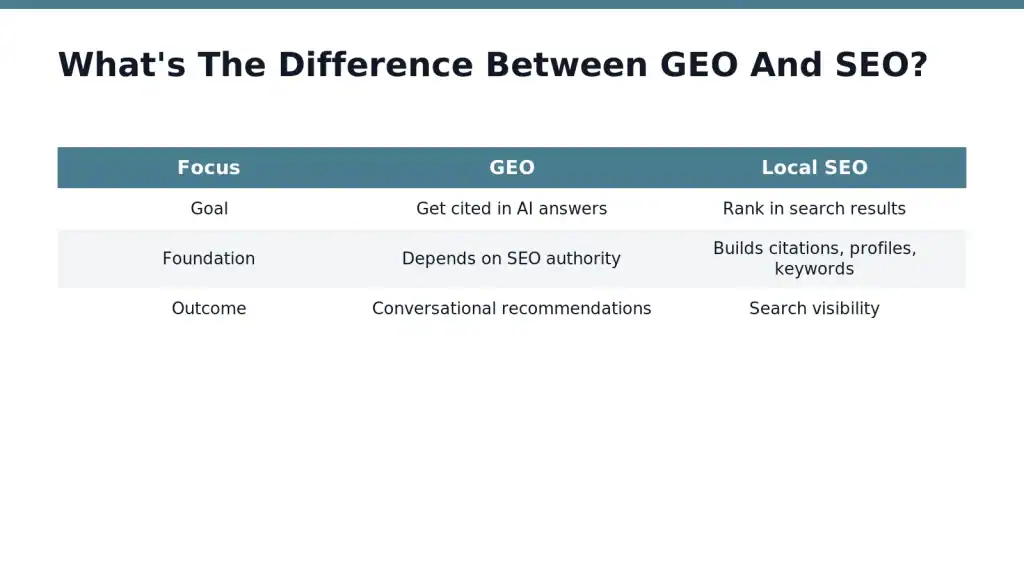
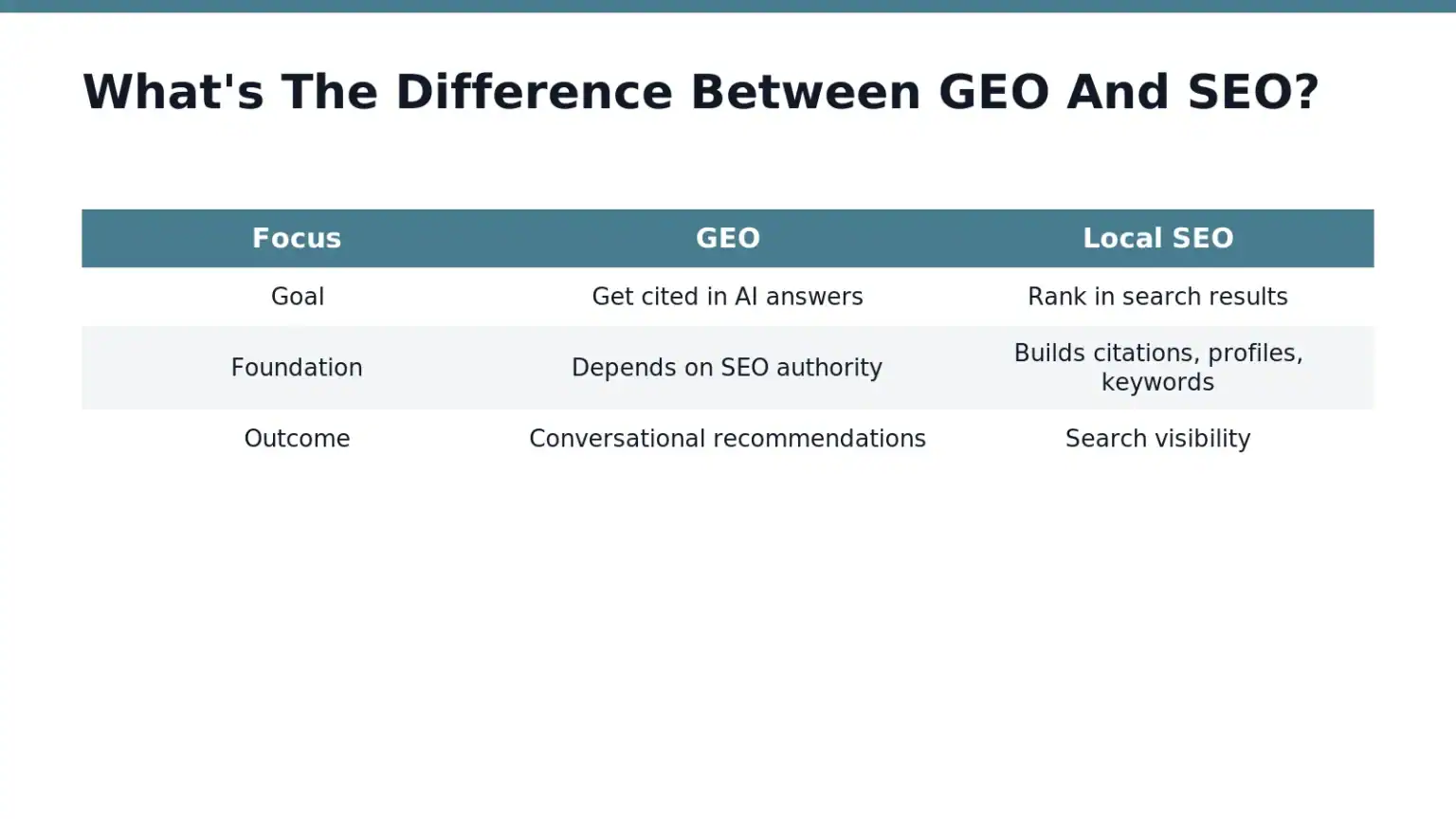
What’s The Difference Between GEO And SEO?
Generative Engine Optimization (GEO) earns a local business a mention inside AI-generated answers, while local SEO earns that same business a spot in traditional search rankings. Both matter. Neither replaces the other.
GEO makes a business the trusted source that AI models cite when shoppers ask conversational questions, whether through Google’s AI Overviews or ChatGPT. A shopper typing “best HVAC repair near me” into an AI assistant gets a short, direct answer, not ten blue links to sort through. GEO determines whether a local business becomes the name in that answer.
Local SEO does different, foundational work. Citations, a complete Google Business Profile, and locally relevant keywords build the authority signals that AI systems lean on before they ever cite anyone. Skip that foundation, and GEO has nothing credible to point to.
Does GEO replace local SEO?
No. GEO and local SEO work best together, not as substitutes. We build local SEO first because it establishes the trust signals AI engines scan before generating a recommendation, then layer GEO strategy on top to capture conversational search traffic.
Which one should a growth-stage business prioritize first?
Local SEO fundamentals come first for most businesses we work with. A business without consistent citations or a fully optimized Google Business Profile has little chance of being cited by an AI model, no matter how well-written its content is.
Businesses that run both strategies together dominate search rankings and AI-generated summaries at the same time. That’s the outcome we build toward for every growth-stage client. For strategy breakdowns like this one delivered straight to your inbox, Get The Weekly Spark.

How Do AI Engines Decide Who Gets Recommended?
AI engines select a short list of trusted businesses instead of ranking every option available. That shift matters for local businesses competing for visibility in conversational search results. We see this pattern across every industry we work with: search is moving away from a wall of links and toward a single, synthesized answer.
Picture a customer asking an AI assistant for the best plumber, the top-rated bakery, or a reliable landscaping crew nearby. The generative engine doesn’t return ten blue links for the customer to sort through. It picks a handful of businesses worth naming, and it explains why.
That selection process rewards clarity and authority. Businesses with consistent information, verified credentials, and clear service descriptions get named. Vague or inconsistent listings get skipped, even when the underlying business is excellent.
What makes an AI engine choose one business over another?
AI recommendation engines weigh factors like proximity, service accuracy, and how well a business’s information matches the customer’s actual question. Consistency across platforms plays a role too. A local business with mismatched hours or outdated service lists gives the AI engine less confidence to recommend it.
Does this replace traditional local search rankings?
No, it works alongside them. Traditional signals still build the foundation the AI engine draws from, but the output format has changed. Instead of a ranked list, customers get a curated set of recommendations, often just three or four businesses.
Here’s what typically separates the businesses that get named from the ones that don’t:
- Clear, accurate service and location details across every online listing
- Strong reputation signals, including reviews and ratings
- Content that directly answers common customer questions
We help growth-stage businesses build that foundation. Get The Weekly Spark for practical strategy on staying visible as AI reshapes local search.

Is Your Google Business Profile Losing You Customers?
Yes, an incomplete profile costs local businesses real customers every single day. Gaps in hours, categories, photos, and service descriptions push potential buyers toward competitors before they ever pick up the phone. We see this pattern across the local businesses we work with nationwide: the profile looks “done” but isn’t actually complete.
The numbers back this up. Local SEO and GEO: How Local Businesses Get Found in 2026 found that businesses with complete Google Business Profiles convert 3.2 times more often than those with incomplete listings. That’s not a marginal edge. A fully built-out profile, one with accurate categories, updated hours, service menus, and regular photo uploads, does far more heavy lifting than most owners realize.
Mobile search makes this urgent. The same research found that 76% of “near me” mobile searches lead to a store visit within 24 hours. Someone searches, finds a business nearby, and shows up the same day. If your profile is thin or outdated at that exact moment, you lose the visit to whoever’s listing looked more trustworthy.
What makes a Google Business Profile “complete”?
A complete profile answers every question a customer might ask before calling. That means verified hours, a primary and secondary category, a written description of services, current photos, and regular posts or updates. Missing even one of these elements signals neglect, and neglect reads as unreliability to both customers and the algorithm.
How fast should local businesses fix profile gaps?
Immediately. Given that 76% of near-me searches convert to a visit within a day, every week a profile sits incomplete is a week of lost walk-ins and calls. We treat profile audits as a first step, not an afterthought, for every growth-stage client. Businesses that want ongoing strategy delivered straight to their inbox can Get The Weekly Spark, our newsletter built for founders scaling past local guesswork.
Does Structured Data Actually Boost AI Visibility?
Yes, schema markup measurably improves how AI engines surface local businesses. Local SEO and GEO: How Local Businesses Get Found in 2026 found that content with proper schema markup shows 30 to 40% higher visibility in AI-generated answers. That’s not a marginal edge. For a growth-stage business competing against dozens of local operators for the same customer question, a 30 to 40% visibility gap decides who gets named and who gets skipped.
We treat structured data as the translation layer between a business and the machines summarizing it. Search engines and AI models parse raw web content, but structured data spells out exactly what a business offers. It operates, and how customers reach it, removing guesswork from the equation.
Do all AI engines require structured data?
No, they don’t require it uniformly. Google states its AI features work without special markup, relying instead on its own understanding of page content. Other AI engines, however, may lean on structured data to fill gaps their models can’t infer alone, so skipping it still leaves visibility on the table.
We don’t recommend treating structured data as optional just because one engine claims it isn’t mandatory. The 30 to 40% visibility elevator applies broadly, and businesses that skip it hand competitors an advantage for free.
For growth-stage businesses managing every dollar carefully, structured data delivers:
- Clearer entity signals that reduce misattribution in AI-generated answers
- Faster indexing of business details across engines with varying requirements
- Compounding returns when paired with strong local SEO foundations
We build this groundwork into every GEO engagement we run nationwide. For ongoing strategy breakdowns like this one, Get The Weekly Spark, our newsletter built for founders scaling past the noise.
How Are Voice Search And AI Assistants Changing Discovery?
Customers increasingly skip the search results page entirely. Instead, they ask a voice assistant or an AI chatbot to find a local solution and expect a single, confident answer back.
We see this shift play out in real customer behavior. Someone asks “Hey Google” or “Hey Alexa” where to find a plumber open right now, or types the same question into an AI chat window. Ten years ago, that query returned a map pack and a list of nearby options. Today, the assistant often just names one business.
What Does an AI Assistant Actually Say When Asked for a Local Recommendation?
Rather than surfacing a review list or a map pack, the assistant may respond with a direct recommendation: naming one specific business, its address, and its hours, sometimes citing a source behind the pick. No scrolling. No comparing five options. One answer, one business, one shot at being chosen.
That one-shot format changes what “ranking well” even means for local businesses. Consider the difference:
How Do We Help Local Businesses Win That One Answer?
We build generative engine optimization (GEO) into every local marketing strategy we run. The businesses that structure their online presence for AI comprehension are the ones assistants trust enough to name. A business we’ve optimized for GEO stands a stronger chance of being the recommendation an assistant delivers, not just an entry buried in a list nobody reads past the third result.
For founder-led businesses competing in this new landscape, subscribe to “Get The Weekly Spark” for the strategy updates we send on AI visibility and discovery trends.
What Local SEO Foundation Does GEO Depend On?
Local SEO means optimizing a business’s online presence so it appears when nearby customers search for its products or services. Without that foundation, generative engine optimization has nothing to build on. AI systems still need clean data, consistent citations, and real reputation signals before they’ll ever mention a business by name.
We treat local SEO and GEO as sequential, not competing, investments. Get the fundamentals wrong, and no amount of conversational content saves the business from being invisible in AI-generated answers.
Why Does Local GEO Need Proximity and Reputation Data First?
Local GEO is the version of generative engine optimization built specifically for local intent. Proximity signals, entity data, and reputation determine who gets named when an AI tool summarizes an answer for a nearby search. None of those signals exist in a vacuum; they come from the same citations, reviews, and profile data that local SEO already establishes.
What Comes After the Foundation Is Set?
Once the basics are solid, advanced GEO work layers on top. That means building authoritative FAQs and guides that anticipate the long-tail, conversational questions real customers actually type or speak into an AI assistant. Think less “plumber near me” and more “why is my water heater leaking from the bottom.”
The distinction we come back to with every growth-stage client:
- Local SEO helps a business show up in search results.
- Local GEO helps that same business get chosen inside the AI-generated answer.
We build campaigns in that order for a reason. Skipping the foundation to chase GEO tactics wastes budget on visibility that never converts. Businesses that want a steady rhythm of practical updates on this shift can Get The Weekly Spark, our newsletter built for founder-led teams scaling past the noise.
How Can CNV Creative Get You Found Nationwide?
We operate as a fully online marketing partner, built to serve growth-stage local businesses without geographic limits. Distance never determines the quality of strategy or execution local businesses receive from us. We run our operation out of Ohio, but that home base sets no boundary on who we serve. Local businesses across the country work with our team daily through the same remote-first systems.
Results matter more than location. Our clients see an average return on investment of 2,340%, a figure built on over a decade of experience driving growth for businesses that need to compete beyond their own zip code. That track record spans more than 10 years of refining what actually moves revenue for founder-led companies, not just what looks good in a pitch deck.
Does CNV Creative work with businesses outside Ohio?
Yes. We built our entire service model for remote delivery, so local businesses anywhere in the United States get the same strategic attention as a business down the street from our office. Location never limits access to our full-stack marketing capabilities.
How fast can a local business get online with CNV Creative?
Our Website in a Week service launches a professional, high-converting site in just 7 days. Local businesses that need visibility fast, whether launching, rebranding, or fixing an underperforming site, don’t have to wait months for a redesign.
What keeps local businesses working with us long-term comes down to consistency:
- Nationwide service delivery with no local constraints on strategy or execution
- Measurable ROI averaging 2,340% across client engagements
- Rapid deployment through Website in a Week for businesses needing speed
- Decade-plus expertise applied to every growth-stage client
- 4.3-year average client tenure, reflecting compounding results rather than one-off wins
That tenure number tells the real story. Local businesses don’t stay with a marketing partner for 4.3 years on average unless the numbers keep improving. Want strategy delivered to your inbox every week? Get The Weekly Spark and see how we think about growth.
FAQ
What is GEO for local businesses?
Generative Engine Optimization earns a local business citations inside AI Overviews. ChatGPT answers, rather than just ranking in traditional search results. It builds on local SEO foundations like Google Business Profile. Citations, layering authoritative FAQs so AI names the business first.
Do local businesses still need traditional SEO if they invest in GEO?
Yes, local SEO and GEO work together, not as replacements. Accurate listings, strong reviews, and location-specific content remain the foundation GEO builds on to earn AI citations.
How does CNV Creative help local businesses with GEO?
CNV Creative builds both local SEO foundations and GEO readiness into client strategy, drawing on over 10 years of growth experience and an average client tenure of 4.3 years.
Conclusion
In closing, geo-targeting transforms how local businesses connect with their immediate market, turning location data into competitive advantage. The strategic approach we’ve outlined, from keyword optimization to localized content, delivers measurable results when executed with precision and consistency. Local businesses that embrace these tactics position themselves to dominate their geographic markets, build lasting customer relationships, and achieve sustainable growth that extends far beyond their initial service area.